Boating Safety Class Over Zoom

U.S. Department of Homeland Security

Contributed by America’s Volunteer Lifesavers

Date:  Sept.22, 2021

Contact: Doris Thomas, FSO-PA

    Eagle River Flotilla     

    17th U.S. Coast Guard Auxiliary

    (907) 694-3570

    cgauxeagleriver@gmail.com 

Boating safety class via Zoom, Oct. 23-24

EAGLE RIVER, Alaska – "Boat America," a six-lesson course for recreational boaters, will be offered Oct. 23-24 via Zoom by the Eagle River Flotilla, United States Coast Guard Auxiliary.

The class will meet from 9 a.m. to noon on Saturday and Sunday. Students will complete the final exam online at home after the class.

Subjects covered will include small boat handling, trailering, legal requirements including Alaska boating law, navigation rules, emergency procedures and personal watercraft considerations. The cost is $25, which includes the textbook and Eventbrite fee.

Course information is at this link: http://wow.uscgaux.info/pe_class_flyer.php?unit=NAT&course=26972 and the Eventbrite registration link is https://www.eventbrite.com/e/boat-america-tickets-173963658987. Early registration is encouraged so the flotilla has time to mail the textbook to the student before the class. 

Anyone who has questions or can’t register online may contact the flotilla at (907) 694-3570 or cgauxeagleriver@gmail.com.

This course meets the requirements for safety certification in many states and some insurance companies will offer a discount to skippers who have completed the course.

WEBSITES:

Flotilla 2-14, US Coast Guard Auxiliary, Eagle River: http://wow.uscgaux.info/content.php?unit=170-02-14

U. S. Coast Guard Auxiliary in Alaska: http://wow.uscgaux.info/content.php?unit=170

Alaska State Office of Boating Safety: www.alaskaboatingsafety.org

U. S. C. G. Office of Boating Safety: www.uscgboating.org

National Safe Boating Council: www.safeboatingcouncil.org  


Avoid Costly Mistakes with Concrete Floor Preparation

Contributed by Clayton Allison

Diligent homeowners are researching the best options for coating their concrete flooring. Properly prepared concrete surfaces ensure any coatings applied will adhere correctly. The longevity of any concrete coating is dependent on how well it bonds to the surface of the concrete. Meticulous and correct preparation is essential.

There are four commonly used methods to prepare concrete surfaces: Diamond Grinding, Shot Blasting, Scarification and Acid Etching,. The preparation before coating a concrete floor is also referred to as surface profiling. Achieving the correct profile can make or break the adhesion of a new concrete coating.

For professional installers, the most important factor is CSP or Concrete Surface Profile. CSP is a standardized measure for the roughness of a concrete surface. This can range from CSP-1 (smoothest) to CSP-9 (roughest). The thicker the coating system, the higher the required CSP to get a good bond. Thin coating systems do not perform well over time. Commercial coating systems are thicker for good reason—they last longer. This is why professional contractors look for a CSP-3 to CSP-9 for the best bond and performance. To achieve this, professional contractors use diamond grinding, shot blasting and scarification. When the concrete surface is too smooth, coatings bond poorly. This can cause your floor coating to fail over time. The coating may also fail to bond due to the surface not being cleaned properly from dirt, grease, oil, or chemical spills.

It is important to identify if your concrete is sealed. Sealed concrete will not allow a coating to adhere. You can do a simple test to check if your concrete is sealed—pour a cup of water on it. If it absorbs into the concrete, then the surface is not sealed. If the water sits on top of the concrete, then a sealer has been applied. A sealer will prevent any coating you apply from bonding to the concrete. It is recommended to use a Diamond Grinder or Shot Blaster to remove any sealers, glues, caulks, mastics, or previous coatings. Newly poured concrete must be profiled as well (and also must cure for 28 days before coating).

Today, most coating manufacturers no longer recommend acid etching for a multitude of reasons. The best acid etching tends to produce a CSP-1 to CSP-2 profile, which is suitable for only very thin systems. As previously discussed, thin systems have poor longevity. Acid etching results are inconsistent and unreliable. The surface can end up uneven, over-etched or under-etched. Acid etching involves the application of acid to the concrete, then rinsing it off with water. Dangerous if not done correctly—it can damage concrete and cause serious bodily harm as well. The etching process can leave behind a white powdery residue (calcium carbonate) that can cause your coating to fail. Many local and federal agencies have imposed restrictions on washing the acid solution down the floor drain, due to the risk posed to the environment. Most coating manufacturers will no longer warranty a floor prepped with acid.

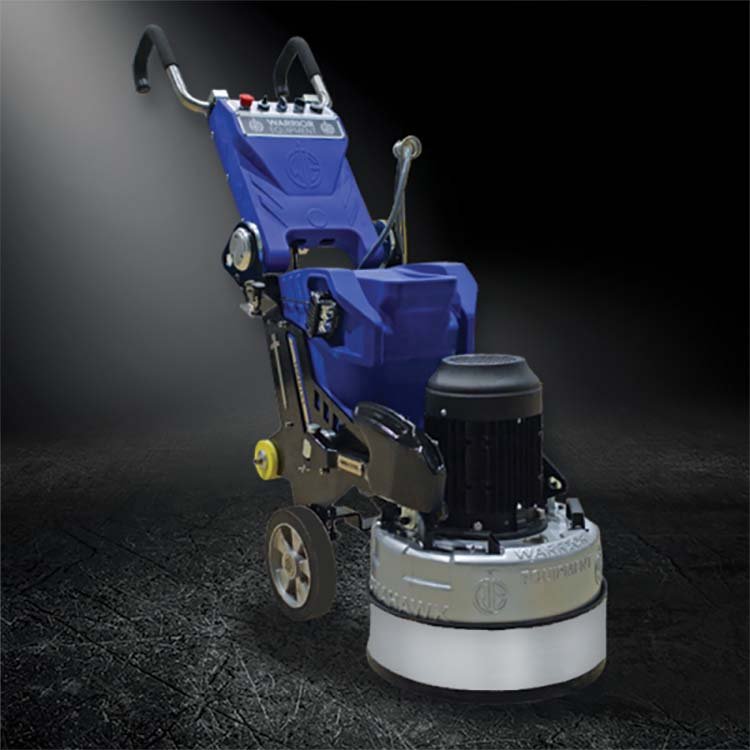
Diamond grinders use rotating discs—special tooling embedded with diamonds—to clean, level and abrade the concrete surface. This allows them to remove the smooth top layer of concrete to expose the raw aggregate beneath. Grinding makes controlling the surface profile easier and ensures a consistent result. A dust containment system or “Pulse Vacuum” is used to collect the concrete dust during grinding. Diamond grinders are versatile and can be used with special tooling to provide more than a surface profile. They can be equipped for concrete polishing systems as well.

Shot blasters use centrifugal force to propel tiny steel shot at high velocity onto the concrete surface. A big advantage of shot blasting when compared to other mechanical methods is it produces very little airborne dust. The process is confined in an enclosed blast chamber that recovers and separates the dust and reusable shot. Magnet brooms are commonly used to collect any stray shot after the job is completed.

Scarifiers allow you to cut or “scar” the surface of the concrete in rows. It uses spinning blades on a drum that rotate at high speed, cutting into the top level of the concrete. These are more aggressive than a diamond grinder or shot blaster. Some models can remove as much as a quarter inch or more of concrete in one pass. These are utilized when you need to remove a large amount of the concrete surface.

When talking to your contractor, ask them which surface profile the manufacturer recommends for the material being installed. If you’re going to be paying for a quality flooring material to be installed, you should make sure that the floor is properly prepared.

Contact us today to learn more about your Professional Installation or DIY options. We have a full equipment line available for rental. You can call us at (907) 671-9900 or visit us at 201 E. Swanson Ave. Suite #1, Wasilla. If you would like a quote for your floor, go to www.AlaskaResin.com and download our Epoxy Project Quote Request Form on our Contact Page.

A Winter Storm to Remember

Contributed by Bill Brokaw

Our mountainside, small three bedroom home, is located at an altitude of 1,500 feet, and about 10 miles from the center of Anchorage. I've lived in this house for 61 years. Winter arrives early and leaves later than winter in Anchorage. The month of March, and the feeling was prevalent that old man winter had been very good to us, with little cold and way-below normal amounts of snow. In fact, I believe January was the warmest on record, and snowfall was practically none-existent. Temperatures on this near-the-end winter March Saturday were in the comfortable mid-twenties, and the forecast called for some snow flurries, or maybe some light snow.

My wife, Pat, left home at 5:30 pm for her ticket-scanning job at the Sullivan Area, located near downtown Anchorage. While enjoying a fire in our old Franklin stove, I was enjoying March Madness college basketball. When darkness arrived in the late afternoon, I did notice that there was some light snow falling.

About half way though the evening I looked through our living room picture window and couldn't believe my eyes. Whiteness so thick that our neighbors house located across Our Road could hardly be seen. Their very bright illuminating yard light was all most impossible to see, and the limited visibility made it appear that the sky was falling. It was a windless night, and the snow was falling a a rate that I've never seen in the 61 years of Alaska living. Curiosity, as the rate of fall got the better of me, so yardstick measuring was necessary. Looking at the clock, I measured the amount on our deck, and an hour later I measured again. It was unbelievable that the hourly rate of fall was almost 7 inches. When it would stop I did not know, but I did know that if the rate of fall continued it would be impossible for my wife to come up our long driveway, and impossible for her to get home from her Sullivan work. She normally arrived home between ten and ten fifteen.

After watching the snow accumulate so rapidly, I thought maybe a phone call to Pat, warning her about the snow depth would be wise. However, the wise call was not made. As the time got later, and the pace of the snowfall continued, I realized that Pat would be in trouble if she decided to drive home. The shill sound of our phone, and Pat's desperate voice told me she was buried in the deep snow located along the Seward Highway. I said to sit tight and I would be there in our old Nissan truck as soon as possible. What a shock is was when the old truck would not start, I hadn't driven it much because of retirement, and turning the key only produced click, click.

What was I to do to rescue Pat? Another phone call, and Pat said the police had stopped and an radioed a wrecker to pull her out. She paid the $70 and said she would be home shortly. However, I had my doubts as the storm had not abated, and I was sure that there would be further trouble ahead for Pat. While waiting and praying, I decided to at least get some of the snow removed from our driveway. It was almost midnight, and Pat should have definitely been home.

Finally, another phone call from a panicked Pat. She literally screamed that she had turned of O'Malley onto the wrong road, and had buried the car big-time. She was over a mile from our home. Since my truck would not start, I was panic-stricken, but was positive that if she started walking, a good Samaritan would stop and bring her home. Not good thinking, but better than no thinking or no action. She did as I asked and started walking through the storm. Sure enough, almost immediately 2 fellows in a pickup truck stopped and brought her home.

I was outside trying to walk through the 24 inch deep snow when the fellows stopped and told me that they had delivered Pat to our home. With a loud voice, uttering my grateful thanks to the good Samaritans, I trudged through the storm to a warm home and a exhausted wife.

The following morning, with the help of a tow line and another good Samaritan, we were able to free her car that was buried, with only a portion of the roof above the snow.

We were both so thankful for the folks that helped us survive another winter experience.