
Fin Whale Makes National News
Contributed by Chandra Brown
When a whale dies, its body descends to the bottom of the deep sea in a transformative phenomenon called a whale fall. A whale’s death jump-starts an explosion of life, enough to feed and sustain a deep-ocean ecosystem for decades.

There are a lot of ways whales can die. Migrating whales lose their way and, unable to find their way back from unfamiliar waters, are stranded. They can starve when prey disappears or falls to predators such as orcas. They become bycatch, tangled in fishing lines and nets. Mass whale deaths have been linked to marine heatwaves and the toxic algae blooms that follow.
Whales can wash ashore. What happens next depends on tide, weather and the creatures – human, avian, canine, scavenger – who share that coastline. Sometimes the dead whale becomes a problem, sometimes a spectacle, sometimes a question no one is ready to answer.
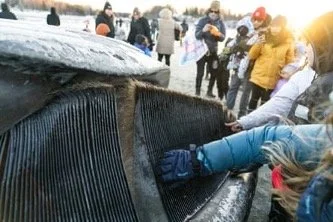
Last winter, one such death unfolded in Alaska, when a young fin whale washed up near downtown Anchorage and froze on to the tidal flats. The aftermath – months of fascination, bureaucratic drift and an unlikely retired air force pilot intent on giving her a second life – showed just how tangled our relationship to dead whales has become.
Scientists and volunteers from the Alaska marine mammal stranding network, dressed in Helly Hansen foul-weather bibs, insulated muck boots, and orange fisher’s gloves, excised quadrilateral chunks of frozen flesh and blubber to create windows to the whale’s interior. While pathology results would take months to come back (and would not, in this individual’s case, reveal any distinct cause of death), scientists saw no evidence of obvious illness, malnutrition or the blunt trauma of ship strike.
To decide what to do with the body, the National Oceanic and Atmospheric Association (Noaa) employs a flowchart, a classic government-issue choice-making matrix, to help officials decide what to do with a dead whale. Considerations include: can you move the whale without its putrefying flesh disintegrating? How much cellular decomposition gas has built up inside?
While Anchorage’s urban coastline has seen a handful of cetacean strandings in recent years, for the fin – a dedicated deep-sea dweller – to have traveled so far inland as the upper Cook Inlet, was strange indeed. No one could figure how this particular whale had died, or what circumstance or current had carried her so far from the open ocean. And while the biologists expected her body to be pulled back into the water with the next big tide, full moons came and went, and she stayed put, her 47ft carcass frozen in place, as days grew shorter and silt turned to ice.
James Grogan, a former air force test pilot turned museum director, was also watching. A self-described “uber ultra wacko conservative”, he had served 23 years in the military. Tall, fit and sporting a buzz cut, he talks fast and looks as if he stepped out of a 1950s military portrait.
Retired and living in Wasilla, he had been volunteering at the nearly defunct Museum of Alaska Transportation and Industry, which opened in Anchorage in 1967 as the Air Progress Museum. With no funding to speak of and faded leadership, the museum was about to shut its doors.
Three years ago, Grogan, who loves an ambitious project, took the helm of that sinking ship. He is now rebranding as the Museum of Alaska, of which he is the director, curator, painter, grant writer, cleaner all in one. And to keep the museum alive, he needs to engage the community – especially the young people.
As he followed the case of the Anchorage fin whale, it dawned on him: if he could bring the whale to the museum, he could reconstruct her skeleton for display and give her the “chance to keep teaching”. As no one else seemed to want or know what to do with the whale, he began researching what it would take to get her to his museum.
Ultimately, In March, Grogan earned permission to harvest the whale from the tidal flats at Fish Creek. He recruited volunteers, including university students in white hazmat suits and Wasilla high school students, who moved blubber to a more favorable location, where the next tide was likely to wash it away. Even with all the help, the process was more than he had bargained for. “I was ignorantly thinking the whale would be like a moose. I could just go over there one afternoon, harvest the whale, & take the bones. It took me three weeks.”
Knee-deep in whale carcass alongside scientists and academics, Grogan found himself surrounded by people with worldviews that were starkly different from his own. “I’m like a flat Earther,” he said, recalling debates with volunteers as they labored side by side, covered in rancid cetacean offal and sea muck.
“Flat Earther” is an improbable qualifier to Grogan’s previous title of pilot. When I highlight this incongruency, he jogs it back a bit, assuring me that, no, he doesn’t actually believe the Earth is flat. But when he is in a room with “a lot of parchment”, with researchers or scientists or people with fixed opinions, he leans into the way he assumes they perceive him. Because he is an outspoken conservative, and he does not subscribe to the ideologies touted by your typical museum curator or natural historian.
“Her pelvis bones are like this big.” With his index finger and thumb, he makes the gesture for something improbably tiny, which whale pelvises are. A commonly held theory is that whale pelvises are vestigial, which means they are regarded as now-useless remnants of whales’ terrestrial past: evolutionary leftovers. Many cetaceans have vestigial hind limbs, phantom leg-bones that are no longer attached to the rest of the skeleton and instead “float” in the flesh, seemingly without purpose – beyond, perhaps, corroborating an evolutionary trajectory from land to water.
For Grogan, though, anatomy and fossil records do not add up as proof of evolution.
“When we started carving her up, some of the biologists from the university were like, ‘Well, that just shows evolution at work.’ And I’m like, ‘Yeah, or the work of the great Creator that did this.’”
“Here’s the largest mammal in the world, who eats the tiniest animals [krill, plankton], and sucks it all in through that silly baleen. So again, when people say ‘evolution’, I say, why in the world would she want to do that? Why wouldn’t she just grow legs and eat steak like the rest of us?”
A month later, in late April, Grogan and a few volunteers went back out, this time with a burly Hägglunds all-terrain rig, generously donated by RentAlaska. When temperatures warm, the mud becomes soft and dangerous, taking on characteristics of quicksand. There are signs on the coastal trail warning hapless out-of-state walkers to stay off the mudflats. “I believed and respected the mudflat rumors,” Grogan said, “but I really had no idea.”
‘Whales were Alaska’s first industry,’ said James Grogan, the executive director of the Museum of Alaska.
The crew collected what bones they could before a high tide suddenly floated the carcass, sending it west. Grogan deemed it too dangerous to go back out on to the mud in a vehicle. He asked around for a crane. He was about to give up.
Then, a week later, another big tide shoved what was left of the fin squarely up against the shore. “A friend called and said: ‘Hey, she’s back!’” That same afternoon, Grogan and a volunteer from Alaska Veterinary Pathology Services were back at the carcass.
They staked the vertebrae to the beach, hoping she would stay put through one more high tide. Anxiously, Grogan waited. That tide went out, and he scrambled back out to the whale, hopeful. With chainsaws and volunteers from Vulcan towing company in Anchorage, he said: “We got her out!”
Once the bones were on the trucks and headed north to Wasilla, all that was left of the fin was a slick of blubber and fleshy residue, floating just off the shore.
The whale, now beneath mounds of manure and hay, microbes eat at the remaining flesh of the rest of the whale’s bones. The process is called maceration, and you can do it in the Earth or in maceration tanks, which are essentially big, stinky aquariums. Grogan said he was gleaning what wisdom he can from curators who have done this before. He did not know how long maceration would take, given Alaska’s extreme temperatures, and he still needed to identify funding to complete the fin whale project.
Alaska has always been an oil state: at first, it was oil from whales and now it’s oil from the Earth, from the seafloor. “Whales were Alaska’s first industry,” he said. Indeed, 100 years before crude was tapped at Prudhoe Bay, the Yankee whaling fleet hunted Arctic whales to the brink of extinction.
“As much as I’m ‘drill, baby, drill’”, Grogan said, he also wants the Alaskan maritime industry to take a beat and consider the consequences of unchecked progress. In terms of offshore oil extraction, he said: “There’s got to be a responsible way to drill that considers the animals on the North Slope.
“From the beginning of human history, written history, God gave us responsibility. We have to do the right thing, even though the right thing might be tough.” For Grogan, the ineffable complexity and beauty of the fin whale supports the story he believes, the biblical story of dominion. “God put us in charge to be stewards, not to abuse that power.”
To that end, Grogan said he was now attempting to work with state leadership to introduce legislation to protect all whales – not just the endangered Cook Inlet belugas – from ship strike. “Let’s keep those ships moving,” he said – but not at the expense of whales.
When asked how his work with the fin whale had changed him. “I’m a pilot. I believe in science and physics. But I’m outside the box when it comes to history and floods. If anything, [the fin whale] has solidified my beliefs. When I got inside of her and saw her amazing complexity on a non-cellular level – tendons, fins, how her snout is designed to let her dive down to 2,000ft, and chambers in her cranium, all unbelievably complex – I think, there’s got to be a Creator out there who said: ‘I’m gonna make this creature unique.’”
With an impish grin, Grogan reflected on his transformation. “I went from being a ‘let the world burn’ kind of guy, to a conservative save-the-whales Greenpeace fanatic.”